|
Four Thirds Sensor Size and Aspect Ratio
|
|
|
My other articles related to the |
|
The Four Thirds sensor is still, after five years since it was introduced, a source of controversy, discussions, and flaming wars. Some people see it as the future of digital SLR photography, others — as an evolutionary dead end. Most of that focuses on the sensor size itself: just one-half of linear dimensions of the 35-mm film frame. While most of the issues can be cleared out with use of some common sense and grade school math, the same questions and concerns are being raised over, and over, and over. This article is an attempt to put some relevant facts and arguments together, in one place, so that they can be more easily accessible. How small the Four Thirds really is? The Four Thirds frame dimensions are 13.0×17.3 mm. This is the actual image area, not that of the whole sensor, which may include parts not participating in the image. Some manufacturers (for example, Nikon) do not publish the net sensor size, opening the field for some misunderstandings. | |
|
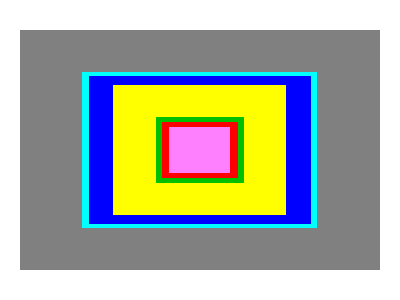
Here is a comparison of common digital camera frame sizes. In the decreasing order, these are:
24×36 mm ("full frame" for those born after 1990) APS-C (Nikon): 15.6×23.5 mm APS-C (Canon): 14.8×22.2 mm Four Thirds: 13×17.3 mm 2/3": 6.6×8.8 mm 1/1.7": 5.7×7.6 mm 1/2.33": 4.6×6.1 mm |
|
|
The difference between APS-C and Four Thirds is not really significant, especially after taking into account that most of it in the longer dimension is usually cropped anyway to fit the image into one of the standard print sizes. In terms of image height, APS-C is 14% (Canon) or 20% (Nikon) bigger. The trend in today's non-SLR cameras is towards smaller sensors; most superzoom EVF models (Nikon P90, Canon SX10 IS, Olympus SP-590UZ) use 1/2.33" or smaller. 1/1.7" can be seen in better compacts (Canon G10), while 2.3", previously used by Canon, Nikon, Olympus, and others, has been largely abandoned. Again, the difference between the thwo smallest sizes in this comparison is not worth arguing about. Note on the Nikon APS-C format: The actual image size has not been published, but it can be calculated from other available data. The D300 uses a 12 MP Sony CMOS sensor with the pixel pitch of 5.49 micrometers as published by Sony; at 4288×2848 pixels gives 15.6×23.5 mm. To sum things up, size-wise at least:
The aspect ratio The image proportions are an important and often underestimated issue. Putting the square format aside (it was introduced out of necessity for cameras which, for viewing convenience reasons, could not be used in two orientations), most of the formats common in the last 100 years had one of the two common aspect ratios: 4:3 or 3:2. Of these, the more frequent 4:3 was usually a result of a choice, while 3:2 — of technical practicality (halving or doubling of a 4:3 frame results in a 3:2 one). The latter was usually cropped to provide more pleasing results. For good or worse, when Oscar Barnack designed the Leica prototype back in 1913, he decided to use the inexpensive and readily available cinematographic film (35 mm width, double perforation). The standard film frame was 18×24 mm (4:3 aspect), too small for any decent results with the existing emulsion technology, therefore Leica's frame was covering two standard film frames: 24×36 mm (3:2 ratio). The rest is history: after a few decades the "miniature" (35-mm) cameras dominated the market, and the 3:2 aspect firmly established itself as a standard, except for medium-format and plate cameras. Most of the "standard" print sizes, however, remained more squarish than that, except for the smallest, "drugstore" prints of 3.5×5" and 4×6" ones. Do not misunderstand me: some images will look better in the 3:2, or even more elongated, proportions (after all, this is the aspect ratio chosen by Leonardo for his Mona Lisa painting); some landscapes may even ask for a 2:1 one, and a rare one will hit the sweet spot when cropped square — but if you crop your prints to what looks best, you will end up in most cases with something close to 4:3. I did, even in my film years, shooting on a 3:2 film. When viewing photographs posted on the Web by some 35-mm purists, always sticking to 3:2, I'm most often under the impression that the image would be stronger if cropped to something shorter. Is this just me? Maybe, but probably not. While the image aspect ratio deserve a separate discussion, I have no doubt that the 4:3 proportions usually require less cropping than 3:2 ones. This defies the purpose of SLR viewing, supposedly making it easier to compose the picture; when shooting film I often had to visualize how my frame will look after being shortened. This, actually, was one of the main reasons I chose the Four Thirds format. The noise issues Being not educated on a given subject may be sometimes better than being half-educated: it is less likely to result in voicing wrong opinions. This may sound harsh, but I cannot refrain from it after watching some discussion threads on online photography forums. "Four Thirds sensors have to be more noisy because they are so small; APS-C ones show less noise because they are so much bigger." Excuse me? Have a look at the picture above, comparing sensor sizes. Need I say more? If this or that camera with an APS-C sensor shows less noise (which really may become relevant only at ISO above 400), it is not because the sensor size; there are three more factors involved here:
For more on the noise issues, see my Noise in Digital Cameras article, a general introduction to the subject, and stay away from consumer magazines. Depth of field It turns out (see my DOF article) that cameras with smaller sensors have more depth of field — assuming the same image angle, subject distance, and lens aperture (F-number). This is a mixed blessing:
One size does not fit all, not in this case. The same argument was raised against the 24×36 mm film when it was competing for popularity against the medium format; and earlier — when the latter was pushing aside 9×12 cm plate cameras. Still, in general more pictures suffer from the lack of DOF (due to the depth of the subject, or just to imprecise focusing) than from too much of it. You cannot have both advantages within the same image size. For applications which require shallow DOF, a full-frame (24×36 mm or, even better, medium-format) camera will be more suitable; for others — a For Thirds (or APS-C) one will have an advantage. (Again, ignore the differences between Four Thirds, APS-C, and Foveon/Sigma; they are too small to count here.) Lenses: size and weight When the Four Thirds system was introduced with the release of the Olympus E-1, there were hopes raised that the lenses following this standard would be smaller (and therefore lighter) than their counterparts for 35-mm film cameras. Those expectations were based on the assumption that the frame half the 35-mm size will require lenses half as big. Halving of the (linear) size means reducing the volume (and therefore the weight) by a factor of eight: quite an enticing prospect! Things are rarely as simple as they seem at the first glance. Digital sensors are quite directional, i.e., less sensitive to light rays which are not perpendicular (or normal) to the surface. It is not enough to reduce lenses by a factor of two; they also have to be moved away from the image plane, at least lenses of focal length below 50 or 80 mm. Indirectly, this also leads to the lens front element being much larger than the ratio of the focal length to F-number would indicate. The bottom line is that most of the lenses for smaller image formats (be it Four Thirds or APS-C) are as large as their 35-mm film equivalents for similar angles of view. The size advantage starts to show only at longer focal lengths (200 mm EFL or longer). One may say "still, if I use a 50 mm lens designed for a film SLR on a digital (Four Thirds) body, I get a 100 mm EFL, and the lens itself is not becoming bigger". Well, this is true, but this lens, not being optimized for digital sensors as described above, will not perform as well as a "digital" one. First of all, even with a full-frame, 24×36 mm sensor, it does not take into account the difference in the directional sensitivity of the medium; second, it is designed to provide the resolution sufficient for a 24×36 mm frame, requiring half as much magnification for the same print size. To be honest, many 35-mm film lenses, especially primes (non-zooms) in the telephoto range, are good enough for the higher magnification required for digital SLR images and will perform just great on a Four Thirds (or APS-C) body. We should not, however, take this for granted. A company serious about using legacy lenses on a digital body is Leica. To reduce the sensor size impact in their new M8, the frame size is 18×27 mm (equivalence ratio, M=1.33), and the microlenses on top of the sensor photosites are tilted in order to change the sensor angular response. The latter may be especially important, as Leica wide-angle lenses do not use the inverted telephoto design, moving them away from the film — there was no need for that without the moving mirror in a rangefinder camera. How well does this work? I don't know, not having $5000 to burn on a luxury camera, as good as it may be. There is one more digital-specific issue, although it is not related to sensor sizes. The sensor area, together with the filter surfaces immediately in front of it, is significantly more reflective than a film surface. Light scattered from that area undergoes secondary reflections from lens surfaces (especially, but not only, rear-facing ones), and this may lead to undesirable general lowering of image contrast and, worse, ghost images. Lens manufacturers started addressing this problem by using more effective anti-reflective coating, but legacy lenses do not have this advantage. The bottom line: do not expect lenses for smaller-format (Four Thirds or APS-C) cameras to be much smaller than their film counterparts of the same image angles. This advantage is visible only at the long focal lengths. Still, the two new Olympus "kit" lenses, 14-42 mm F/3.5-5.6 and 40-150 mm F/4.0-5.6 are impressively small, especially the latter one. This, however, always some compromises to be made. Sensor resolution limits With the "classic" Bayer pattern sensor (two green, one blue, and one red-filtered photosite in a 2×2 square), the pixel pitch may go down as low as perhaps three micrometers (0.003 mm) until it approaches any physical limits causing significant undesirable effects. After all, the Canon G7 (or the A640) gets 10 MP out of a 1/1.8", 5.3×7.1 mm sensor; that's a pixel pitch of about 1.9 micrometers (0.0019 mm), less than half of that of the 10 MP Olympus E-400. At a 0.003 mm pitch, the Four Thirds sensor will provide a resolution of about 25 million pixels (really: photosites), or 24 "binary" MP. That's plenty — if you care. I don't. And this is with the pixel area more than twice that in the current cameras I just mentioned, based on the current technology. When I hear people claiming that the Four Thirds format is incapable of providing resolutions above 10 MP, I just laugh. Then, hearing the same "experts" say that APS-C sensors can deliver such resolutions, just because they are bigger, I don't know whether to laugh or to cry. Stop worrying about pixels, start thinking about lenses. Or just start thinking. | |
|
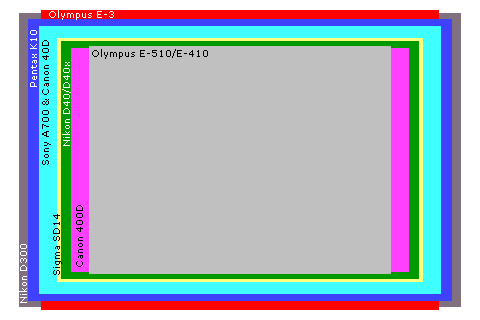
A side effect: viewfinder size By its very nature, the viewing screen in your SLR's viewfinder is at the same optical distance from the lens as the sensor, and, for a 100% coverage, should have the same size as well. Therefore smaller sensors mean smaller screens, and smaller screens mean smaller apparent size of the finder frame — unless the screen image is additionally magnified on its path to the viewer's eye. Increasing this magnification costs, however, extra — in terms of size, weight, and production expenses. This is why most digital SLRs (let's exclude ones with full-sized 24×36 mm sensors from this) suffer, to a various degree, from a "tunnel vision" syndrome. If someone argues about that, show him or her almost any half-decent film SLR from the late Seventies. This will bring things into proportion. As the Four Thirds system uses the smallest sensor among digital SLRs, it is most prone to this effect. This is one of the reasons I'm getting quite a lot of email from the people willing to acquire, say, an E-510 or E-3, but are worried about this factor. To save time, I've prepared a diagram, showing relative (apparent) viewfinder sizes for some SLR lines. I have chosen some of the upper-shelf, advanced cameras (Nikon D300, Canon 40D, Olympus E-3), some considered "entry level" (although this term should be used for photographers, not cameras), and some in-between. Here it is. | |
|
Comparison of apparent viewfinder sizes for a number of selected digital SLRs. Roughly from edge to center: Nikon D300 Pentax K10 Olympus E-3 Canon 40D and Sony A700 Sigma SD14 Nikon D40/D40x Canon 400D Olympus E-510, E-410, E-520, E-420 (An updated version, including recent camera models, can be found in a my article on finder size.) |
|
|
The comparison is not so straightforward if cameras of various aspect ratios are involved. One may argue that what really counts is the height, as most images are cropped from the longer side to proportions closer to 4:3 than to 3:2. Thus, for example, the finder image for the Olympus E-510 is a tad taller than that for Canon 400D, even if the latter more than makes up for this in the width dimension. The counter-argument may be that for images cropped to a more oblong format, it is exactly the width which counts. Oh, well. It seems, however, clear that the dividing line is drawn according not to the sensor size, but to price of the camera. Clearly, the D300, 40D, and E-3 belong to one group (joined by the K10 and A700 which are a bit less expensive, and therefore in a twilight zone), while the "economy" models, like E-510, D40, or 400D — to another. Therefore it is not the sensor size — just the money you're willing to pay! Conclusions The size-related considerations discussed above are similar to those I went through back in 2004 before deciding to settle down on the Four Thirds system. Without a significant investment in lenses (except for some manual focus Minolta ones and a wide collection in the Exakta mount), I did not have to worry about lens legacy. Without any advantage or disadvantage in terms of image size as compared to the APS-C format, my choice was open (excluding the 24×36 mm option mostly, but not only, for economy reasons). What tipped the scales in favor of Four Thirds were (a) the 4:3 aspect ratio, (b) availability of Four Thirds, digital-specific lenses of good or great quality, (c) the ultrasonic anti-dust system used by Olympus, and (d) my general affinity to the way in which Olympus engineers solve problems and make the necessary compromises. Your needs and your taste may be different. If you are considering the Four Thirds format as your photography platform, I hope this article may help you to make your own decision. If you already are a Four Thirds user — well, at least it may give you a perspective at some of the issues. Note that this article is mostly limited to sensor size issues; others are touched only in that context. | |
|
|
My other articles related to the |
| Home: wrotniak.net | Search this site | Change font size |
| Posted 2006/10/08; last updated 2009/02/26 | Copyright © 2006-2009 by J. Andrzej Wrotniak |